Why is the grazing angle of the acoustic pulse on the bottom so important in multibeam backscatter, and even more important when generating multispectral backscatter imagery? Look at the road surface in the two photographs below.
Technical note — Multibeam
Multibeam Backscatter Grazing Angle
Why the grazing angle of the acoustic pulse matters in multibeam backscatter — and why it matters even more when generating multispectral backscatter imagery.
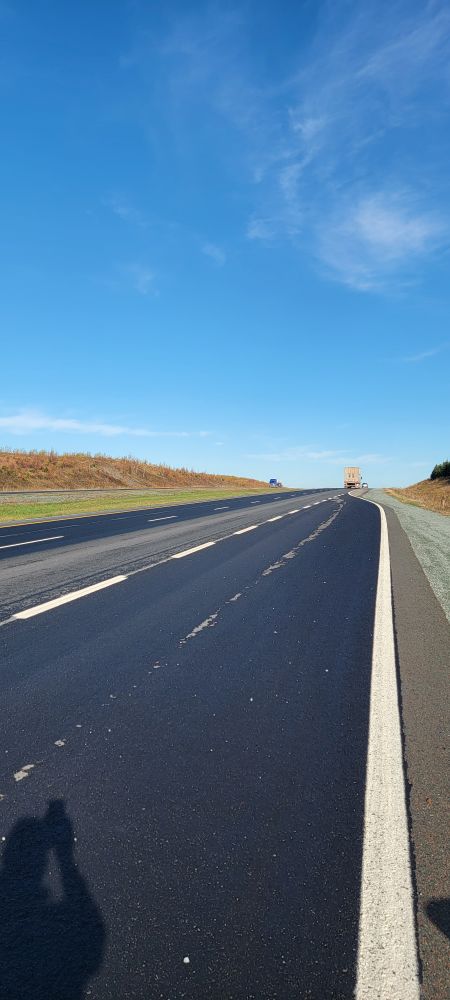
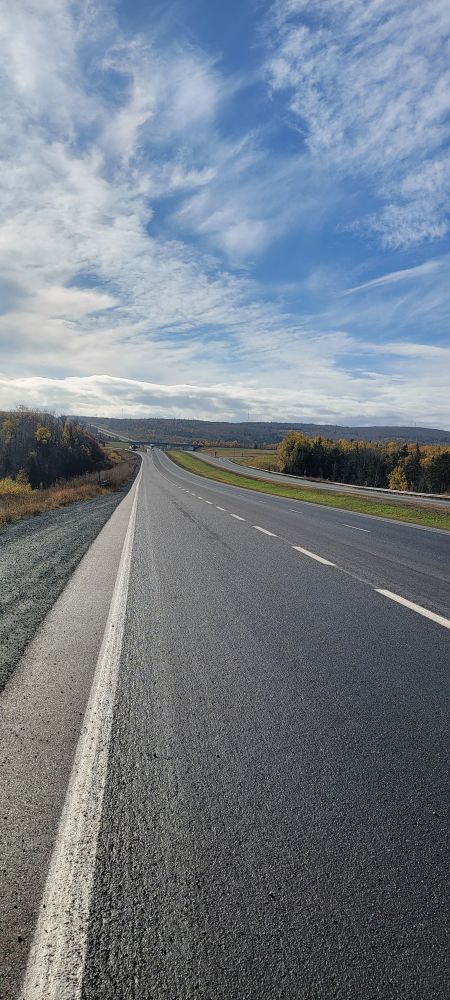
The same road surface, photographed within moments of each other in opposite directions. Note how different the colour appears.
The two pictures above were taken within moments of each other, looking in opposite directions. Take note of the colour of the road surface in the two photos. Why is it so different?
GRAZING ANGLE!
In these two pictures, the grazing angle of the transmitter (the sun) is constant at approximately 60 degrees, but the grazing angle of the receiver is 130 degrees in the left-hand image and approximately 40 degrees in the right-hand image. The road surface's colour (backscatter) changes with the grazing angles.
If you wanted to create a composite image from the two, the road colours' mismatch would confuse the new image. It is the same for multispectral backscatter.
To successfully create a coherent RGB composite multispectral backscatter image, the grazing angle of the transmitter and receiver must be equal for each frequency. Specifically, you must use a multibeam sonar capable of more than one frequency — interleaved or simultaneous — as you survey the bottom.
Three passes at three different frequencies (or n passes at n different frequencies) change the grazing angles, thus changing the backscatter response, making a composite image confusing to the eye and to any algorithm trying to classify the bottom.
Peer-reviewed resources
- Multispectral Multibeam Echo Sounder Backscatter as a Tool for Improved Seafloor Characterization — Brown et al.
- Harmonizing Multi-Source Sonar Backscatter Datasets for Seabed Mapping Using Bulk Shift Approaches — Misiuk et al.
- Multiple imputation of multibeam angular response data for high resolution full coverage seabed mapping — Misiuk & Brown